call us: +31203311214
call us: +31203311214
Bar Trackers vs Multi-Camera Tracking Systems
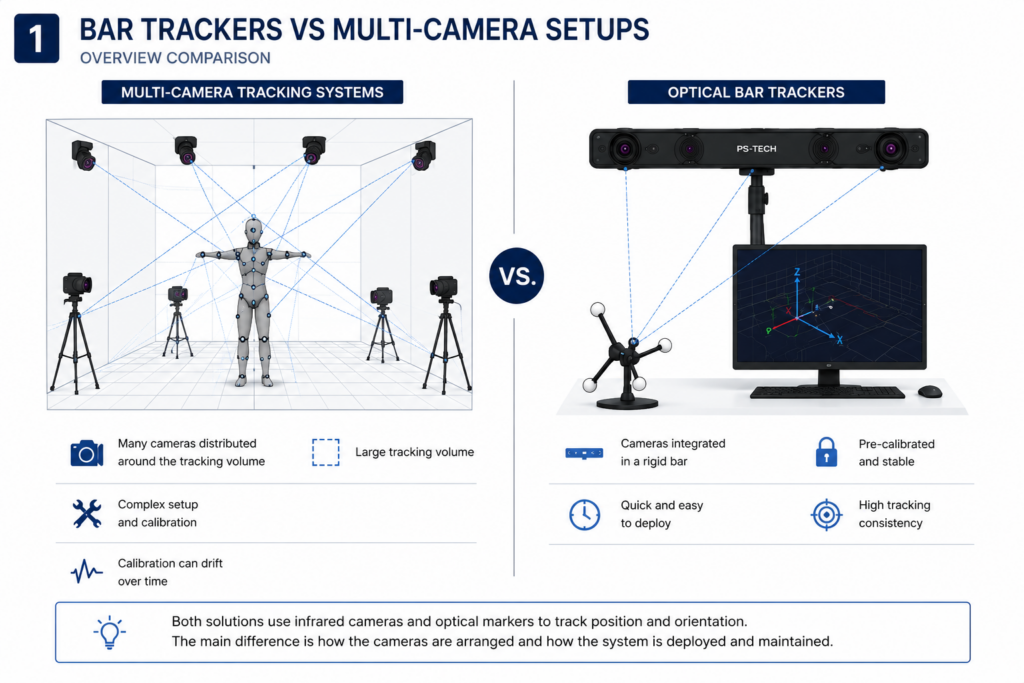
Bar trackers vs multi-camera tracking systems is one of the most important comparisons when choosing an optical tracking solution. Optical tracking systems are widely used in virtual reality, simulation, medical navigation, robotics, and research environments. While many people associate optical tracking with large multi-camera motion capture setups, optical bar trackers have become an increasingly important alternative for professional tracking applications.
Both technologies rely on infrared cameras and optical markers, but they are optimized for different goals, environments, and workflows. Understanding the differences is important when selecting the right tracking solution for a project or application.
What Is a Multi-Camera Tracking System?
Multi-camera optical tracking systems typically use several external cameras positioned around a room or tracking volume. These cameras observe reflective or active markers from different angles and combine the data to determine the position and orientation of tracked objects.
This approach is commonly used in:
- motion capture studios
- large research environments
- animation and film production
- full-body tracking applications
Because multiple cameras surround the environment, these systems can create large tracking volumes and support complex body tracking scenarios involving many markers and subjects simultaneously.
However, multi-camera systems often require:
- extensive calibration
- careful camera placement
- controlled environmental conditions
- regular maintenance and recalibration
The setup complexity increases as the number of cameras grows.
What Is an Optical Bar Tracker?
Optical bar trackers use a different approach. Instead of distributing many cameras throughout a room, the cameras are integrated into a rigid pre-calibrated stereo tracking bar.
This creates a compact and stable tracking system where the relative geometry between the cameras remains fixed. Because the cameras are permanently aligned within the same device, setup and deployment can often be significantly simpler.
Bar trackers are widely used in:
- VR and simulation
- medical visualization
- desktop VR systems
- engineering environments
- industrial research
- CAVEs and powerwalls
At PS-tech, the PST Pico, PST Base, and PST Iris tracking systems are designed around this optical bar tracking approach.
How Optical Tracking Works
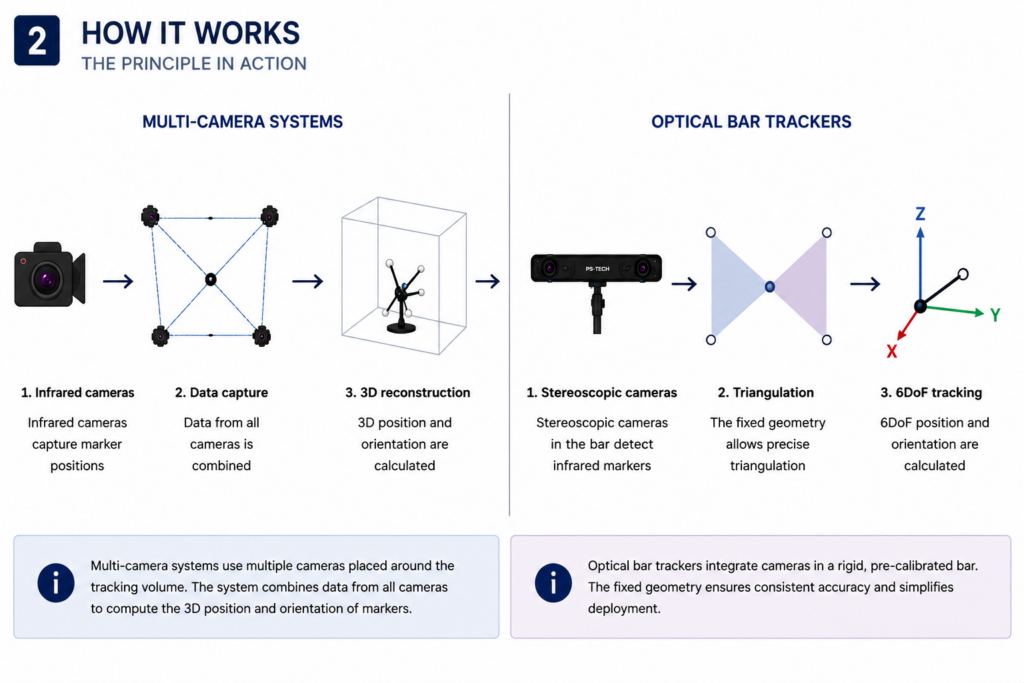
Both multi-camera tracking systems and optical bar trackers use optical triangulation to determine the position and orientation of tracked objects. The fundamental principle is similar: multiple cameras observe markers from different viewpoints and use this information to calculate precise three-dimensional coordinates.
How Multi-Camera Tracking Works
In a multi-camera tracking system, several cameras are positioned around the tracking volume. Each camera captures the markers from a different angle. Specialized software combines the observations from all cameras and reconstructs the marker positions in three-dimensional space.
The system continuously updates these calculations to provide real-time tracking data. Because many cameras contribute to the solution, large tracking volumes and complex tracking scenarios can be supported.
The basic workflow is:
- Multiple cameras observe the markers.
- Marker positions are detected in each camera image.
- Software combines observations from all cameras.
- A 3D position and orientation are calculated.
- Tracking data is delivered to the application.
How Optical Bar Trackers Work
Optical bar trackers use a similar triangulation principle, but the cameras are integrated into a single rigid tracking device. The relative position of the cameras is fixed and calibrated at the factory.
When markers are detected by the stereo camera pair, the system calculates their 3D location using the known geometry between the cameras. Because the camera arrangement remains fixed, deployment is often simpler and highly repeatable.
The basic workflow is:
- The stereo cameras observe the markers.
- Marker positions are detected in both camera images.
- Triangulation calculates the 3D marker coordinates.
- The position and orientation of the tracked object are determined.
- Real-time 6DoF tracking data is delivered to the application.
Both approaches can provide highly accurate tracking data. The main difference lies not in the underlying optical principles, but in how the cameras are deployed and calibrated within the tracking environment.
Comparison Set Up: Bar Trackers vs Multi-Camera Tracking systems
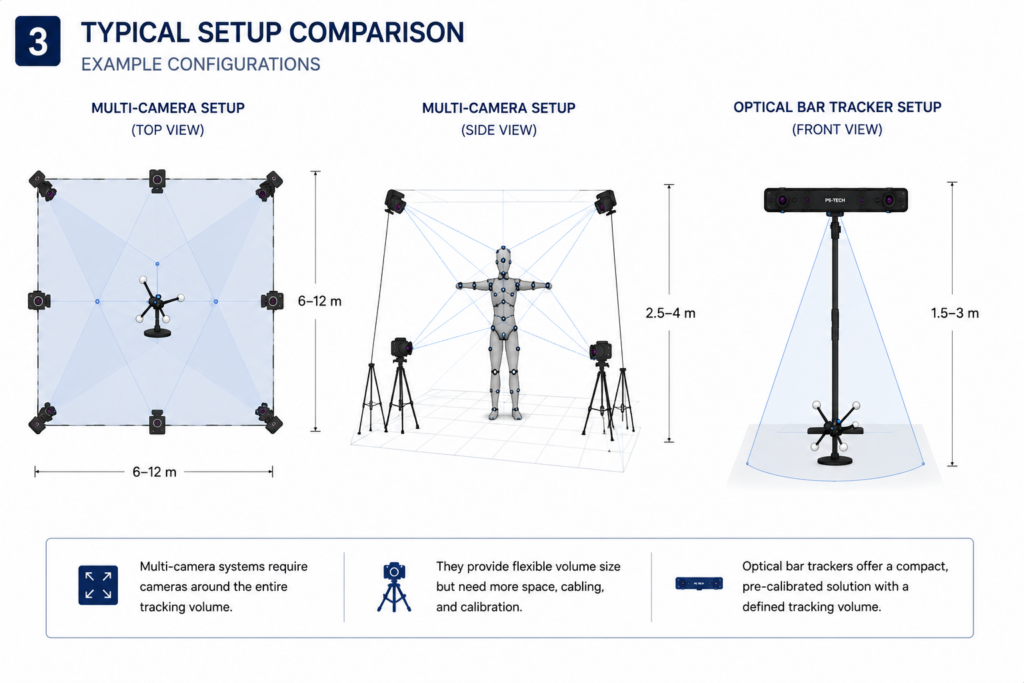
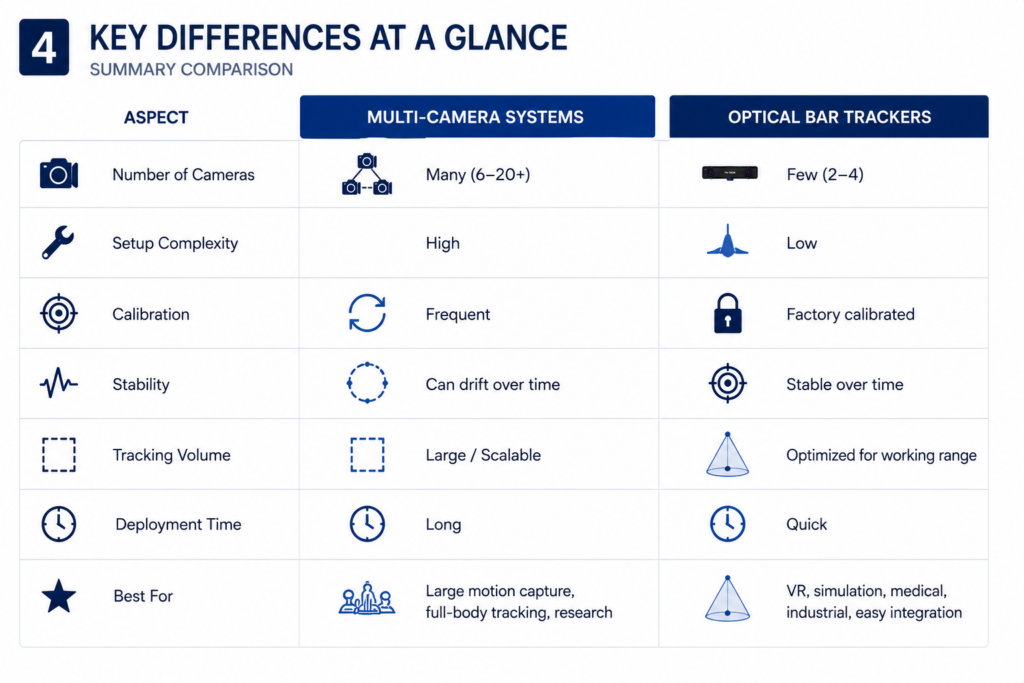
There is no universal “best” optical tracking solution. Multi-camera tracking systems and optical bar trackers are optimized for different applications, environments, and workflows, each offering distinct advantages depending on the tracking requirements. The following sections compare these technologies in terms of stability and calibration, tracking volume and flexibility, and the factors that most often influence system selection.
Stability and Calibration
One of the main advantages of optical bar trackers is tracking consistency.
In distributed multi-camera systems, every camera must maintain accurate alignment relative to the others. Environmental changes, vibrations, or accidental movement of cameras can influence calibration quality over time.
With a rigid stereo bar tracker, the camera geometry is physically fixed. This can improve repeatability and simplify deployment, particularly in professional environments where systems are used daily and reliability is important.
For many VR and simulation applications, users prefer a tracking solution that:
- starts quickly
- requires minimal recalibration
- remains stable over long periods
- can be integrated easily into existing hardware setups
This is one of the reasons bar trackers are commonly used in simulators, research systems, and medical environments.
Tracking Volume and Flexibility
Both technologies can support large tracking environments, but they achieve this differently.
Multi-camera systems expand coverage by adding additional cameras around the environment. This can provide excellent flexibility for large-scale motion capture.
Bar trackers typically focus on optimized tracking volumes with well-defined working distances and simplified installation.
Examples include:
- short-range desktop tracking
- mid-range simulation tracking
- large immersive VR environments
Different tracking systems are optimized for different distances and fields of view.
For example:
- compact trackers are ideal for desktop or headset-based applications
- mid-range trackers support simulator environments
- long-range systems can cover larger immersive spaces and multi-user setups
Choosing the Right Tracking System
There is no universal “best” optical tracking solution. Multi-camera tracking systems and optical bar trackers are optimized for different applications, environments, and workflows, each offering distinct advantages depending on the tracking requirements
Optical Tracking Solutions from PS-tech
PS-tech develops professional optical bar tracking systems for applications ranging from compact desktop VR to large immersive environments.
The product range includes:
- PST Pico for compact short-range tracking
- PST Base for mid-range simulation environments
- PST Iris for large tracking volumes and immersive setups
Combined with the PST Software Suite and SDK support for C++, C#, C, Python, VRPN, TrackD, REST, and CSV workflows, these systems can be integrated into a wide range of professional applications.
Conclusion
Optical tracking technology continues to evolve across many industries. Both multi-camera tracking systems and optical bar trackers offer powerful capabilities, but they are designed for different priorities and workflows.
For applications where simplicity, stability, and efficient deployment are important, optical bar trackers provide a highly effective solution. For large-scale motion capture and full-body tracking, distributed multi-camera systems may offer greater flexibility.
Understanding the strengths of each approach helps organizations select the tracking technology that best fits their environment and long-term goals.