call us: +31203311214
call us: +31203311214
Optical Tracking Technology Explained
How does it work?
3D Localization and Position Tracking
3D localization technology, or 3D position tracking, is the motion capture of objects in the physical world. It refers to precisely measuring an object’s 3D position and orientation within a defined space relative to a known reference point. This is typically achieved by tracking six degrees of freedom (6DOF): three positional coordinates (X, Y, Z) and three angular coordinates (roll, pitch, yaw).
Accurate 3D localization enables real-time spatial awareness, allowing systems to determine not only where an object is, but also how it is oriented and moving within an environment. This capability is essential in applications such as robotics, industrial automation, medical navigation, and augmented reality, where precise positioning directly impacts performance and safety
Optical Tracking Technology
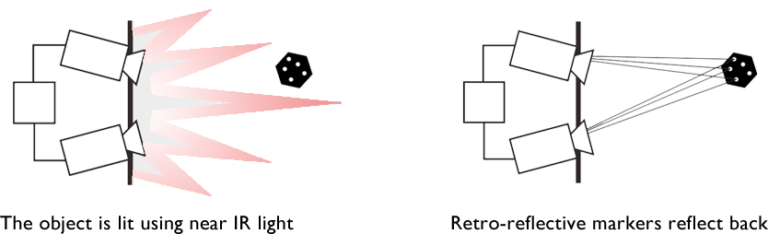
Optical tracking is a 3D localization method that uses two or more cameras to monitor a measurement space. Each camera is equipped with an infrared (IR) pass filter and a ring of IR LEDs that periodically illuminate the space with invisible, safe IR light.
PS-Tech systems use stereoscopic infrared cameras to detect reflective markers in 3D space. Each marker is triangulated in real time, enabling precise 6DoF tracking of tools, objects, or people. This passive marker approach ensures zero interference, ultra-low latency, and sub-millimeter accuracy — ideal for demanding applications.
Advantages of Optical Tracking
Compared to other motion tracking technologies, optical tracking offers several important advantages:
- High accuracy and repeatability – Delivers precise and consistent measurements for demanding 6DoF applications.
- No accumulated drift – Unlike inertial systems (IMUs), optical tracking maintains its accuracy over long periods of time.
- Simultaneous multi-object tracking – Multiple users, tools, and interaction devices can be tracked within the same measurement volume.
- Low latency – Provides real-time feedback, making it ideal for virtual reality, simulation, and human-machine interaction.
- Lightweight wireless devices – Tracked objects can remain compact and untethered, improving ergonomics and user comfort.
- Limited sensitivity to environmental interference – Unlike magnetic systems, optical tracking is not affected by nearby metal structures or electrical equipment.
These characteristics make optical tracking particularly suitable for medical applications, training and simulation, industrial automation, virtual reality, and research environments.
For a broader comparison of optical, magnetic, inertial (IMU), and mechanical tracking technologies, read Tracking Technologies Explained.
| Technology | 6DoF Accuracy | Long-Term Stability | Multi-Object | Setup Complexity | Main Limitation |
|---|---|---|---|---|---|
|
Optical |
Excellent |
Excellent |
Excellent |
✅ Easy |
Requires line of sight |
|
Magnetic |
Very Good |
Very Good |
Limited |
⚪ Medium |
Sensitive to metal |
|
Inertial (IMU) |
Moderate |
Poor |
Moderate |
✅ Very Easy |
Drift over time |
|
Mechanical |
Excellent |
Very Good |
Poor |
❌ Difficult |
Restricted movement |
| Feature | Bar Trackers | Multi-Camera |
|---|---|---|
|
Tracking Quality |
Fixed, precisely defined sensor geometry |
Variable geometry, setup-dependent accuracy |
|
Consistency |
Proprietary optimized calibration |
User-dependent calibration quality |
|
Stability |
Rigid structure, vibration-resistant |
Sensitive to movement and vibration |
|
Ease of Use |
Factory precalibrated, plug-and-play |
On-site calibration required |
Bar Trackers vs Multi-Camera Systems
At PS-Tech, we specialize in optical bar trackers for applications where measurement consistency, reliability, and straightforward deployment are essential.
Unlike conventional multi-camera systems, bar trackers integrate multiple cameras into a single rigid, pre-calibrated structure. This stable geometry reduces calibration effort and provides highly repeatable measurements over time.
Multi-camera systems are often preferred for very large tracking volumes, while optical bar trackers offer a simpler and more predictable solution when accuracy, low maintenance, and ease of integration are the primary requirements.
For a detailed comparison, read Bar Trackers vs Multi-Camera Tracking.
PS-Tech Optical Tracking Systems
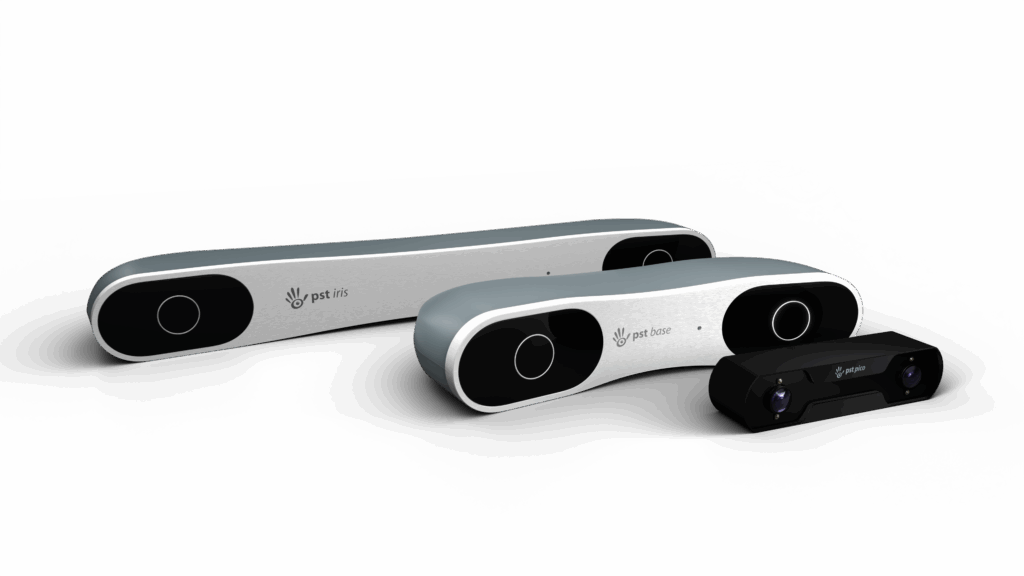
PS-Tech offers optical tracking systems for different ranges:
PST Pico – compact optical tracker for short-range setups
PST Base – mid-range optical tracker for simulation environments
PST Iris – long-range optical tracking system for large volumes
Explore the right solution for your application.
From fundamental principles to real-world implementation, PST trackers translate optical tracking technology into precise, stable, and dependable 3D measurement solutions.