call us: +31203311214
call us: +31203311214
Optical Tracking Technology Explained
How does it work?
3D Localization and Position Tracking
3D localization technology or 3D position tracking is motion capture of objects is the physical world. It refers to measuring an object’s 3D position and orientation within a defined space relative to a known reference point. This is typically done by tracking six degrees of freedom (6DOF): three positional (X, Y, Z) and three angular coordinates (roll, pitch, yaw).
Optical Tracking Technology
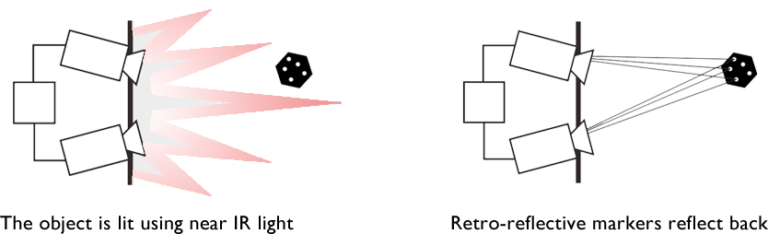
Optical tracking is a 3D localization method that uses two or more cameras to monitor a measurement space. Each camera is equipped with an infrared (IR) pass filter and a ring of IR LEDs that periodically illuminate the space with invisible, safe IR light.
PS-Tech systems use stereoscopic infrared cameras to detect reflective markers in 3D space. Each marker is triangulated in real time, enabling precise 6DoF tracking of tools, objects, or people. This passive marker approach ensures zero interference, ultra-low latency, and sub-millimeter accuracy — ideal for demanding applications.
| Technology | Drift | Noise Sensitivity | Multi-Object | Wireless |
|---|---|---|---|---|
|
Optical |
✅ |
✅ |
✅ |
✅ |
|
Magnetic |
❌ |
❌ |
⚠ |
⚠ |
|
Acoustic |
❌ |
❌ |
⚠ |
⚠ |
|
Gyroscopic |
❌ |
⚠ |
❌ |
✅ |
|
Mechanical |
✅ |
✅ |
❌ |
❌ |
Advantages of Optical Tracking
Compared to other tracking technologies such as magnetic, acoustic, gyroscopic, and mechanical systems, optical tracking offers several benefits:
Resilience to environmental noise: Less susceptible to interference from external conditions.
No drift: Optical systems avoid drift issues common in other technologies.
Simultaneous multi-object tracking: Track multiple objects within the measurement space.
Lightweight wireless devices: Optical systems allow for the use of lightweight wireless interaction devices.
| Feature | Bar Trackers | Multi-Camera |
|---|---|---|
|
Tracking Quality |
Fixed, precisely defined sensor geometry |
Variable geometry, setup-dependent accuracy |
|
Consistency |
Proprietary optimized calibration |
User-dependent calibration quality |
|
Stability |
Rigid structure, vibration-resistant |
Sensitive to movement and vibration |
|
Ease of Use |
Factory precalibrated, plug-and-play |
On-site calibration required |
Bar Trackers vs Multi-Camera Systems
At PS-Tech, we specialize in high-precision bar tracker systems designed for applications where reliability, stability, and measurement integrity are essential.
The structural design and calibration philosophy behind bar trackers create measurable advantages over conventional multi-camera systems
PS-Tech Optical Tracking Systems
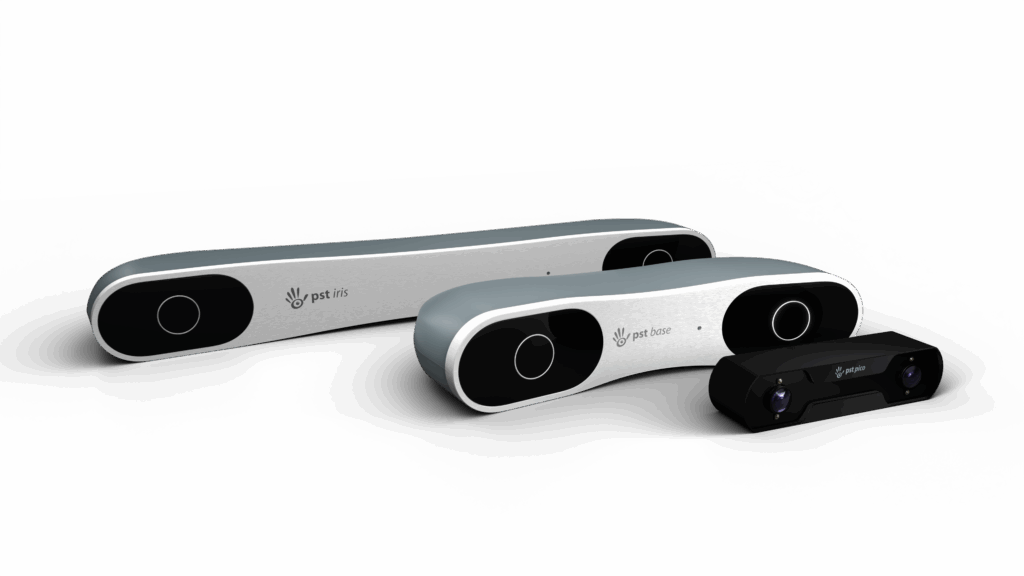
PS-Tech offers optical tracking systems for different ranges:
PST Pico – compact optical tracker for short-range setups
PST Base – mid-range optical tracker for simulation environments
PST Iris – long-range optical tracking system for large volumes
Explore the right solution for your application.