call us: +31203311214
Microflown Acoustic Shape with PST Optical Tracking
Accurate 3D Acoustic Measurements Through Optical Tracking
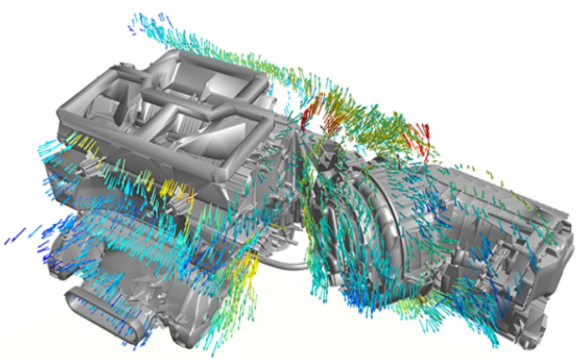
Understanding where sound originates is essential in industries such as automotive engineering, aerospace, industrial manufacturing, and research. Modern engineering increasingly relies on three-dimensional sound visualization to identify, analyze, and solve complex noise and vibration problems.
To solve this challenge, Microflown combined its advanced acoustic sensing technology with PS-tech’s high-precision optical tracking, enabling engineers to accurately visualize sound sources in full 3D.
From Dedicated Measurement Rooms to Portable Acoustic Analysis
Traditionally, acoustic source localization often relied on dedicated anechoic or semi-anechoic chambers equipped with large microphone arrays positioned around the object under investigation. While these setups provide highly accurate measurements, they require significant infrastructure, careful setup, and limited measurement flexibility.
The Acoustic Shape takes a different approach. Instead of surrounding an object with dozens of microphones, a single acoustic probe is moved around the object while PS-Tech optical tracking continuously measures its exact position and orientation.
By combining acoustic measurements with real-time 6DoF tracking, engineers can generate accurate 3D sound visualizations without the complexity of dedicated measurement facilities.
How Acoustic Shape Combines Acoustic Measurements and Optical Tracking
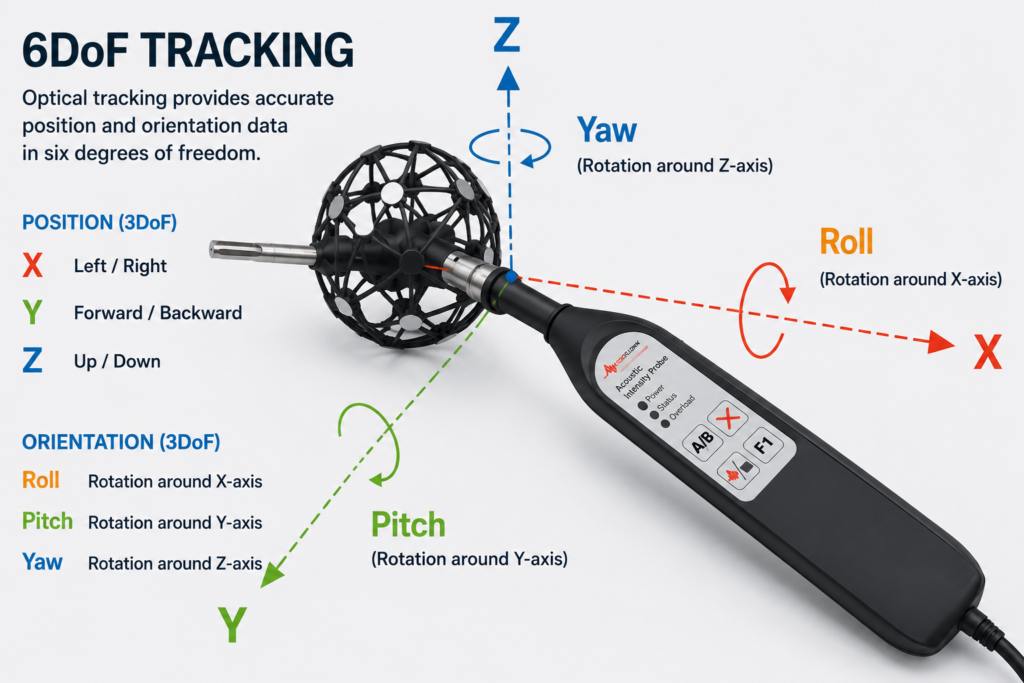
Microflown’s Acoustic Shape solution combines advanced acoustic sensing with real-time optical tracking to create accurate three-dimensional sound maps. As the acoustic probe is moved around an object, the optical tracking system continuously measures its exact position and orientation and synchronizes this information with the acoustic data.
Because every measurement must be linked to precise six degrees of freedom (6DoF) information — X, Y, Z position and roll, pitch, and yaw orientation — optical tracking is essential for generating accurate and repeatable 3D sound visualizations. This enables engineers to quickly identify noise sources, analyze sound propagation, and compare measurements across multiple test sessions.
Why PST Optical Tracking Is Used
To support these demanding measurement workflows, Microflown integrates PS-Tech optical tracking technology into its Acoustic Shape solution.
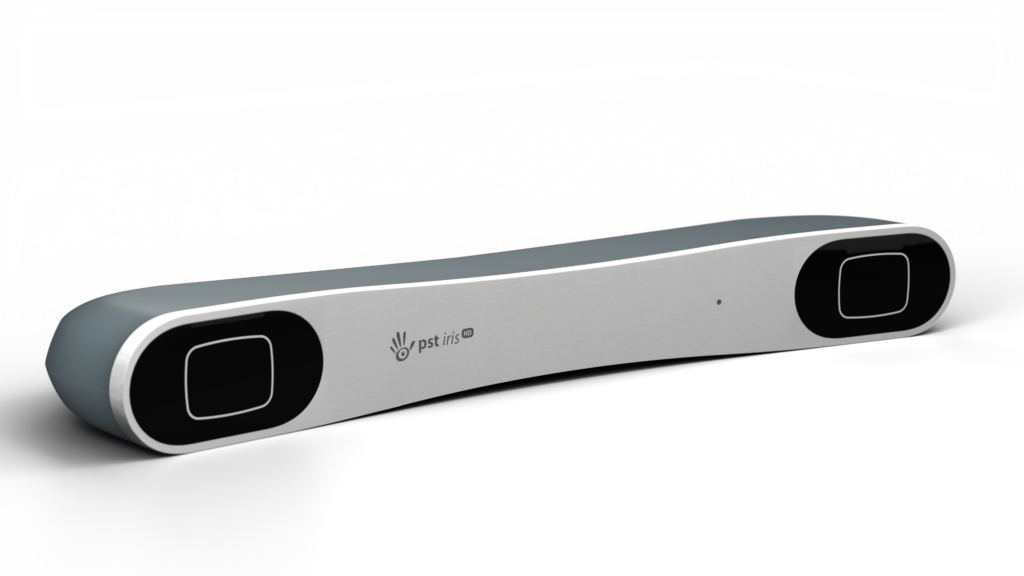
Unlike large multi-camera tracking installations, optical bar trackers provide a compact and easy-to-deploy alternative while maintaining the accuracy required for professional acoustic analysis. You can learn more about the differences in our article on bar trackers vs multi-camera tracking.
Systems such as the PST Base and PST Iris provide:
- Stable factory calibration
- Fast installation and deployment
- Accurate real-time 6DoF tracking
- Reliable long-term performance
- Simple OEM integration
- Support for manual and robotic measurement workflows
Their compact design allows tracking technology to be integrated directly into advanced measurement systems without introducing unnecessary complexity.
Supporting Manual and Automated Measurements
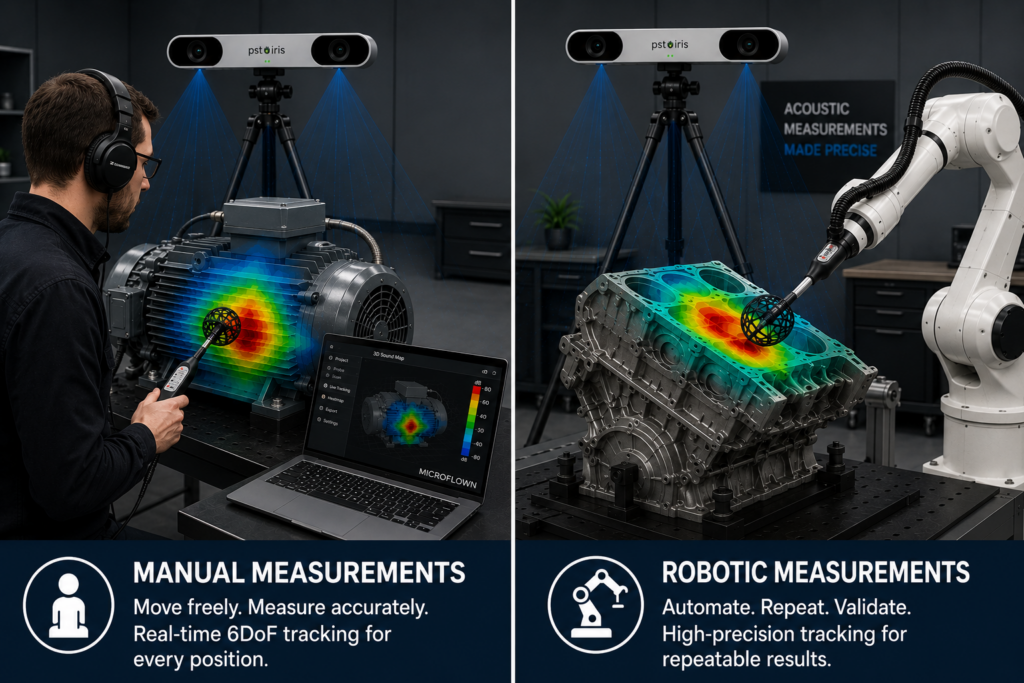
One of the strengths of the Acoustic Shape platform is its flexibility. Engineers can freely move the acoustic probe around an object while the optical tracking system continuously records its position and orientation.
For automated measurements, robotic systems can perform highly repeatable scanning procedures while optical tracking verifies and records the exact probe location throughout the measurement process.
This combination enables efficient workflows for both research and industrial applications.
Applications Across Multiple Industries
The combination of acoustic sensing and optical tracking is used across a wide range of industries.
- Automotive Development – Engineers use 3D sound visualization to identify unwanted noise sources, optimize vehicle designs, and improve passenger comfort. This is particularly important for electric vehicles, where quieter drivetrains make secondary noise sources more noticeable.
- Aerospace Engineering – Aircraft manufacturers use acoustic measurements to investigate vibration behavior, cabin noise, and component performance.
- Industrial Equipment – Manufacturers analyze machinery noise, optimize product designs, and identify maintenance issues before they become critical failures.
- Research and Development – Universities and research institutes use acoustic visualization systems to study complex sound propagation phenomena and validate simulation models.
Accurate, Repeatable, and Easy to Deploy
The Acoustic Shape demonstrates how combining advanced acoustic sensing with precise optical tracking creates a powerful tool for acoustic analysis.
By integrating PST Base and PST Iris optical tracking systems into the Acoustic Shape platform, engineers gain access to accurate real-time position data, reliable 6DoF tracking, and a streamlined workflow that simplifies the creation of highly detailed 3D sound visualizations.
The result is faster analysis, improved repeatability, and deeper insight into the acoustic behavior of complex products and systems.