call us: +31203311214
call us: +31203311214
Tracking Technologies Explained: Choosing the Right Solution
Motion tracking has become an essential technology in many industries. From medical navigation and virtual reality to industrial automation and intelligent mining systems, tracking data enables machines, people, and software to interact accurately in three-dimensional space.
Selecting the right tracking technology, however, is not always straightforward.
Every technology has its strengths and limitations. Factors such as accuracy, range, latency, environmental conditions, and ease of integration all influence which solution is best suited for a particular application.
This article compares the most common tracking technologies used in engineering, simulation, medical, and industrial applications and explains when each solution performs best.
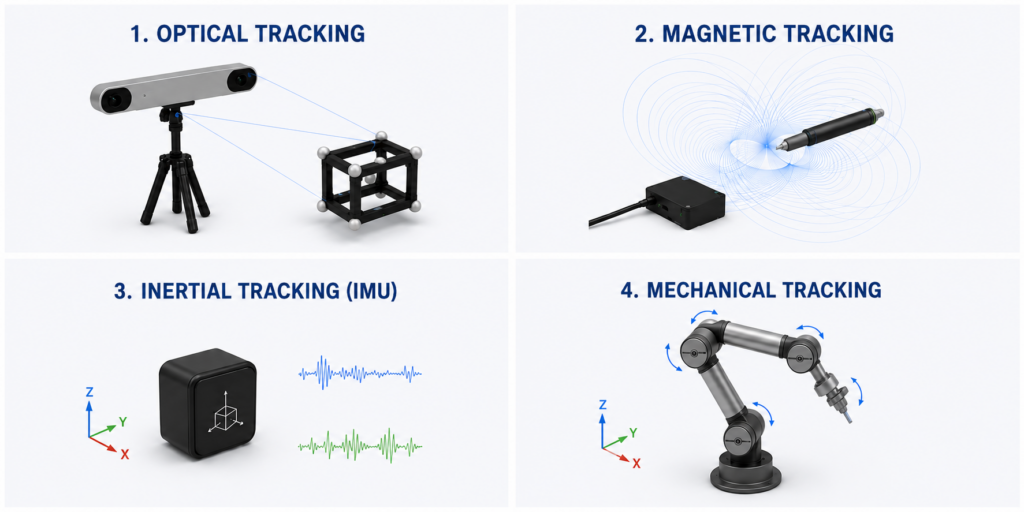
The Four Main Motion Tracking Technologies
Today, four technologies dominate professional applications:
- Optical Tracking
- Magnetic Tracking
- Inertial Tracking (IMU)
- Mechanical Tracking
There is no universal solution that fits every application. The optimal choice depends entirely on the environment and performance requirements.
Optical Tracking
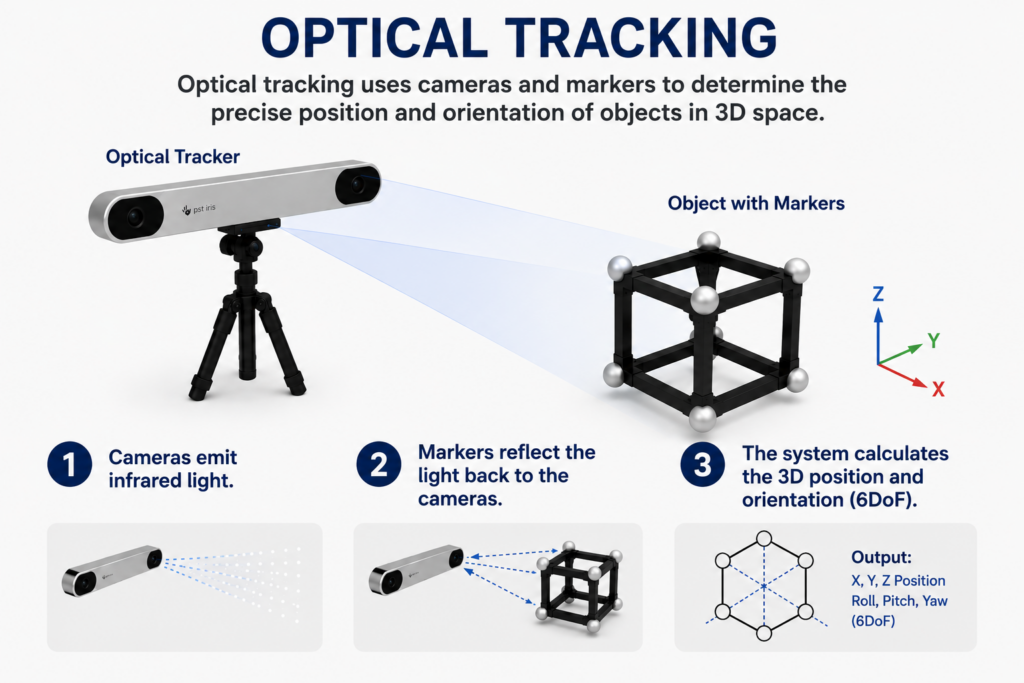
Optical tracking systems use cameras and markers to determine the precise position and orientation of objects in three-dimensional space.
Modern systems track passive reflective markers or active LED markers to calculate all six degrees of freedom (6DoF): X, Y and Z position, as well as roll, pitch and yaw orientation. Many systems can also simultaneously track multiple objects, users or tools, making them well suited for collaborative simulations, robotics and industrial applications.
Typical applications include:
- Medical navigation
- Training and simulation
- Virtual and augmented reality
- Industrial automation
- Research laboratories
- Mining applications
Advantages
- Very high accuracy
- Low latency
- Excellent repeatability
- No physical contact required
- Supports multiple tracked objects
Limitations
- Requires line of sight
- Outdoor operation can be challenging
- Large environments may require multiple trackers
Optical trackers are often the preferred solution whenever high precision is required. While traditionally used indoors, modern systems can also operate outdoors by combining long-range trackers with active LED targets to overcome infrared interference from sunlight.
More information:
Magnetic Tracking
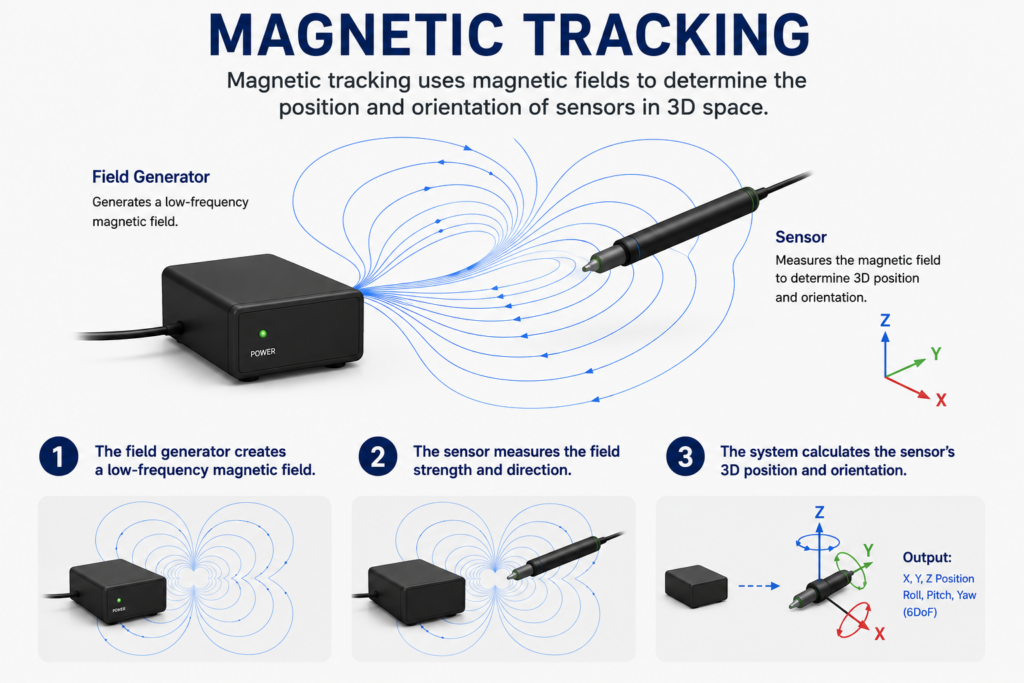
Magnetic positioning systems generate electromagnetic fields and measure their distortion to determine the position and orientation of sensors. Because magnetic fields pass through most non-metallic materials, these systems do not require a direct line of sight between the transmitter and the tracked object.
Magnetic tracking systems can simultaneously track multiple sensors and are commonly used in medical navigation, virtual reality and motion analysis applications where objects may become occluded. However, nearby metal objects and electronic equipment can distort the magnetic field and reduce accuracy.
cations include:
- Surgical navigation
- Catheter tracking
- Medical research
- Human motion analysis
Advantages
- No line-of-sight requirements
- Compact sensors
- Works inside the body
Limitations
- Sensitive to metal interference
- Sensitive to electrical equipment
- Limited tracking volume
Magnetic trackers are particularly useful when optical access is impossible.
Inertial Tracking (IMU)
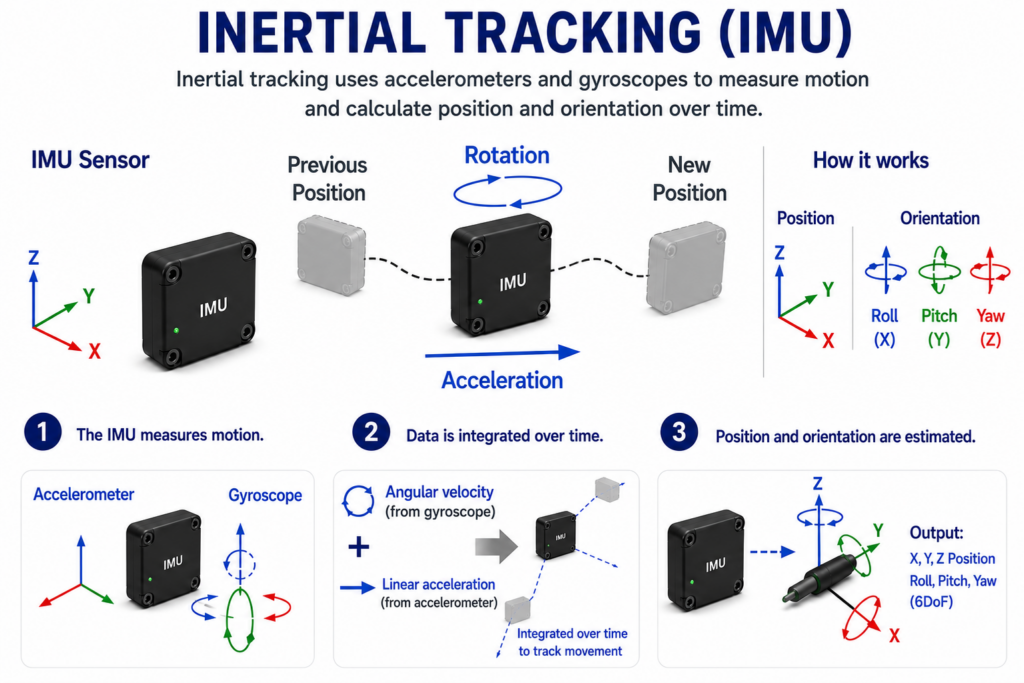
Inertial Measurement Units (IMUs) use accelerometers and gyroscopes to calculate movement and orientation.
Because each device contains its own sensors, IMU-based systems can easily track multiple objects simultaneously. Their main limitation is positional drift, which accumulates over time and often requires additional sensors or technologies to maintain long-term accuracy.
Typical applications include:
- VR headsets
- Drones
- Robotics
- Wearables
- Motion analysis
Advantages
- Small and lightweight
- No external infrastructure required
- Works indoors and outdoors
Limitations
- Accumulates drift over time
- Lower positional accuracy
- Requires periodic correction
For this reason, IMUs are often combined with optical tracking systems.
Mechanical Tracking
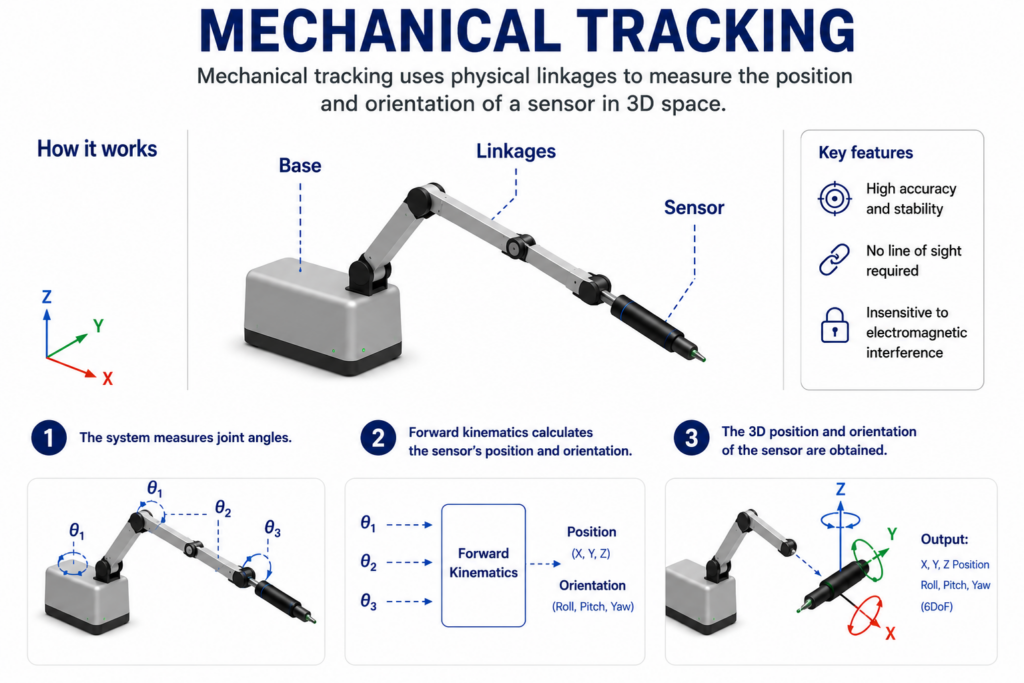
Mechanical tracking systems use physical linkages and encoders to determine position and orientation.
Because the tracked object remains physically connected to the tracking mechanism, these systems provide highly accurate measurements. They are often used in industrial measurement equipment, haptic devices and robotic applications. However, mechanical arms and cables restrict movement and limit the available workspace.
Typical applications include:
- Coordinate measuring machines
- Surgical simulators
- Industrial manipulators
Advantages
- Extremely accurate
- Stable over long periods
- Immune to environmental interference
Limitations
- Physical constraints
- Restricted movement
- Limited workspace
Mechanical trackers are ideal when maximum precision is required within a confined environment.
Other Localization Technologies
Not all positioning technologies are designed for precise 6DoF motion tracking. Some systems are optimized for large-scale positioning and localization.
GPS/GNSS
GPS/GNSS is primarily used for outdoor navigation and large-scale positioning. It is widely used in vehicles, agriculture, surveying, and logistics. While it provides global coverage, its accuracy is insufficient for applications requiring precise 6DoF tracking.
Ultra-Wideband (UWB)
Ultra-Wideband (UWB) is commonly used for indoor localization and asset tracking over larger areas. It can track many objects simultaneously and works well in warehouses and logistics environments, but its accuracy is generally lower than optical tracking.
Comparison of Tracking Systems
| Technology | 6DoF Accuracy | Long-Term Stability | Cost | Ease of Installation | Multi Object | Main Limitation | Typical Applications |
|---|---|---|---|---|---|---|---|
|
Optical Tracking |
Excellent |
Excellent |
Medium |
Easy |
Excellent |
Requires line of sight |
Medical, VR/AR, simulation, industrial automation |
|
Magnetic Tracking |
Very Good |
Very Good |
Medium-High |
Medium |
Limited |
Sensitive to metal and electrical equipment |
Surgical navigation, catheter tracking, medical research |
|
Inertial Tracking (IMU) |
Moderate |
Poor |
Low |
Very Easy |
Moderate |
Drift over time |
Wearables, drones, robotics, VR headsets |
|
Mechanical Tracking |
Excellent |
Excellent |
High |
Difficult |
Difficult |
Restricted movement |
Coordinate measuring, simulators, industrial manipulators |
Selecting the Right Technology for Your Application
Medical Applications
Medical applications often require very high precision. Optical trackers are widely used for surgical navigation and simulation systems, while magnetic trackers are preferred for instruments that operate inside the body because it does not require line of sight.
Virtual Reality and Simulation
Optical tracking is commonly used in immersive VR environments due to its high accuracy and low latency. IMUs are frequently added to improve responsiveness and compensate for temporary occlusions.
Industrial Automation
Industrial automation requires robust and repeatable measurements. Optical trackers are often preferred for its accuracy and flexibility, while mechanical trackers are suitable for applications where movement is physically constrained and maximum precision is required.
Research and Development
Research laboratories often prioritize measurement accuracy and flexibility. Optical tracking is widely used because it is easy to integrate, while IMUs are commonly added when portability or wearable devices are required.
Wearables and Mobile Systems
When size, weight, and portability are the primary requirements, IMUs are often the preferred solution. Their compact design makes them suitable for drones, wearables, and mobile robots, although drift usually requires additional correction methods.
Conclusion
There is no single tracking technology that is best for every application.
The optimal solution depends on the environment, required accuracy, available space, and operational constraints.
Optical systems excel when high accuracy and low latency are required. Magnetic technology is useful when line of sight is unavailable. IMUs offer portability but suffer from drift, while mechanical trackers delivers exceptional precision in constrained workspaces.
The key is not choosing the most advanced technology, but choosing the technology that best fits your application.
Why does PS-Tech focus on optical bar tracking?
Professional applications often require a combination of high accuracy, low latency, and straightforward deployment. PS-Tech optical bar trackers are pre-calibrated systems that simplify installation while maintaining excellent measurement consistency across a wide range of applications.
Learn more: